
ELOTE STREET VENDER MOBILE APPLICATION
A mobile application created to connect users with nearby street vendors, making local food more accessible, discoverable, and trustworthy.
My Role: UX Designer Duration: 1 week Assignment Type: Personal Project
Problem
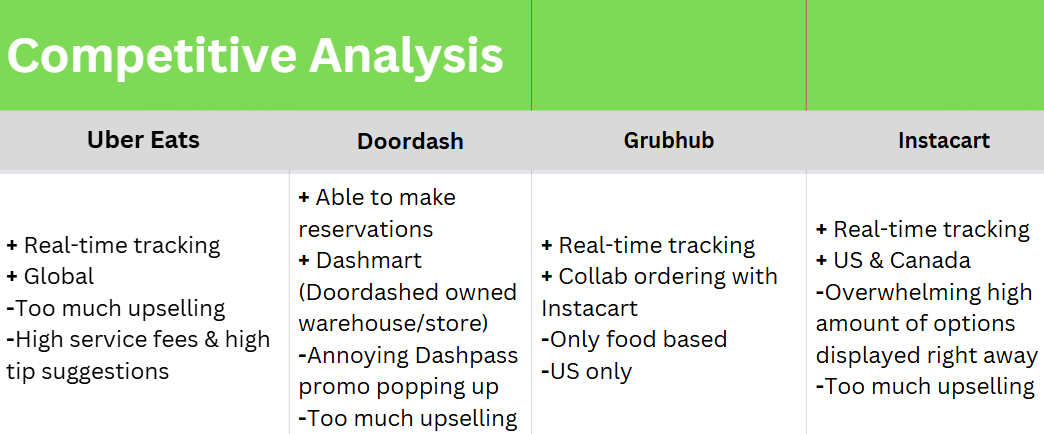
Street vendors are arguably the heart of Los Angeles. Here in LA, we are known for our unbelievable great tasting food and thousands of street vendors. Unfortunately, they can be difficult to locate because for many reasons. Some have random pop-up unusual pop-up schedules, others are mobile, and some often lack a consistent digital presence. Customers typically rely on chance, routine, or word of mouth to find them, making discovery inefficient and unreliable. Additionally, customers may feel uncertain about food quality and cleanliness due to a lack of accessible information, which can create hesitation when trying new vendors
Discovery
User Interviews
I conducted interviews with five potential users of the app: four local residents and one visitor. The goal was to better understand how people currently discover street vendors and what challenges they face when trying to find or order from them.
The research goals were:
Discover how users find street vendors:
Learn how users currently find street vendors, whether through social media, word of mouth, or by chance while walking around.Identify pain points and barriers:
Understand the frustrations users experience, such as not knowing where vendors are located or whether the food is worth trying.Understand what motivates users to explore:
Identify what makes users excited to try new vendors and what would encourage them to explore more frequently.Define user expectations and desired features:
Clarify what users would want from a street vendor app, including features like location tracking, reviews, photos, and ordering ahead.
All interviews were conducted in person.
Insights
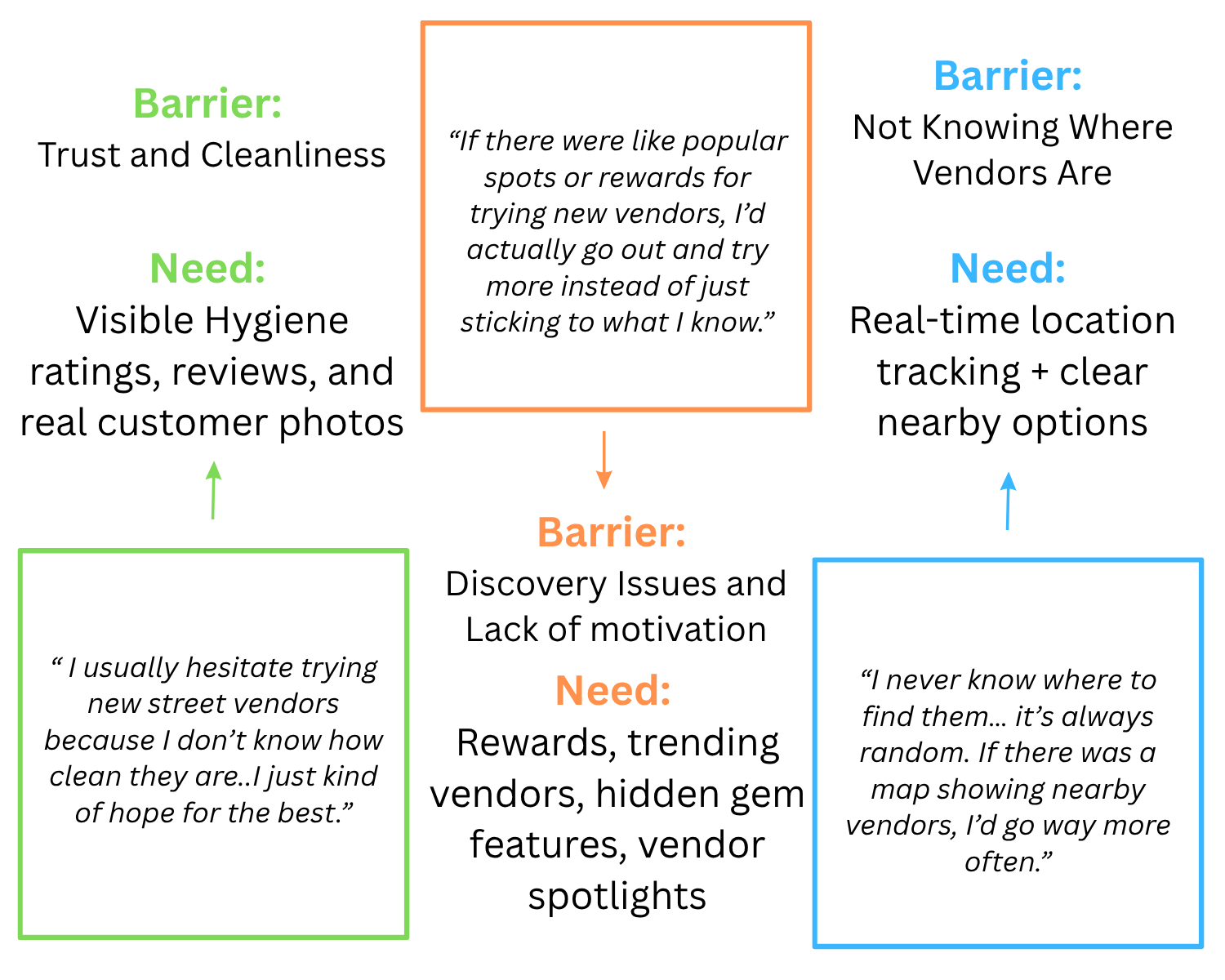
Each major pain point revealed a clear user need:
Difficulty finding vendors → Real-time location access
4 out of 5 users said street vendors are hard to locate since they move around. Users expressed a strong need for a map that shows real-time vendor locations.
Uncertainty and trust issues → Reviews and visual proof
4 out of 5 users mentioned hesitation when trying new vendors due to concerns about cleanliness or quality. They wanted photos, ratings, and reviews to feel more confident.
Inconsistent availability → Reliable and updated information
Users reported frustration when vendors were not where they expected them to be. This created a need for accurate, up-to-date information.
Lack of convenience → Ability to order ahead
Many users said they would be more likely to purchase from vendors if they could order ahead and avoid waiting in line.
User Persona
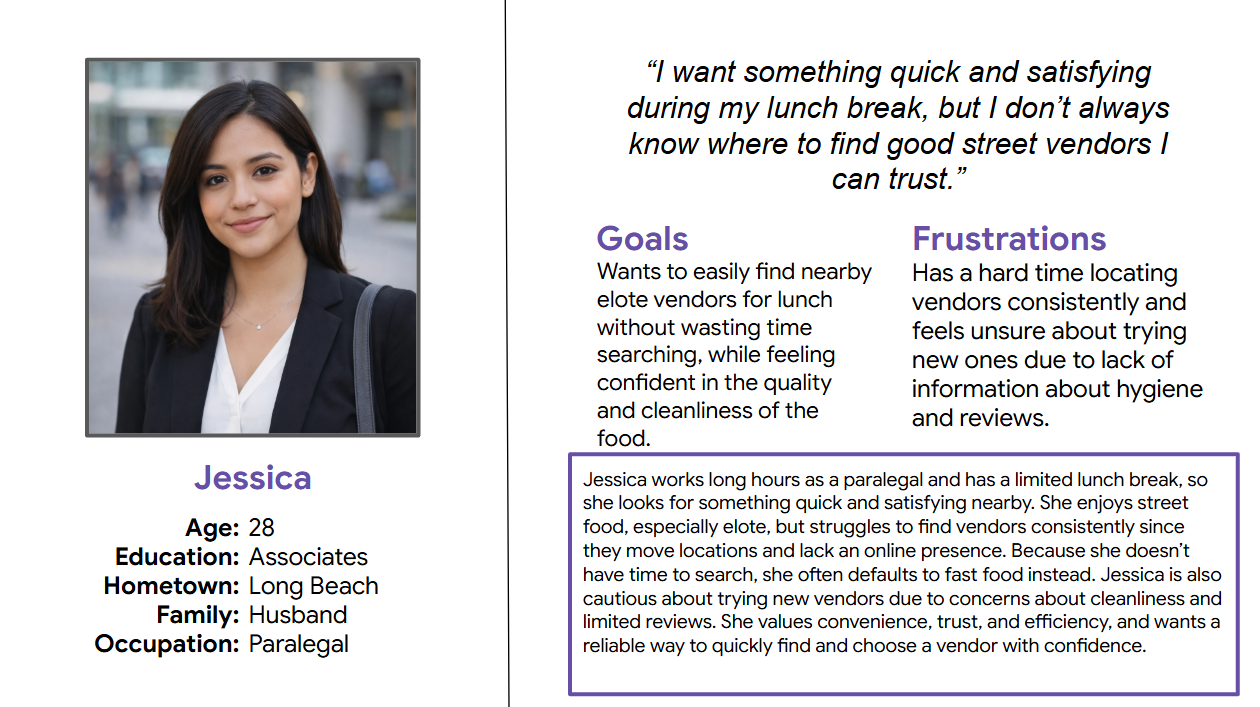
Two user personas were developed; however, the focus is narrowed to one primary persona: Jessica, a time-constrained professional who values convenience, trust, and efficiency when discovering nearby street vendors during her lunch break.
.
POV+HMW
Based on the primary user persona, the following point-of-view statement and how-might-we question were created to guide the ideation phase:
POV Statement
Busy users need a quick and reliable way to locate nearby street vendors, so they can make confident decisions during short breaks like lunch.
How Might We
How might we help users easily find and trust street vendors within a limited amount of time?
Ideation
The ideation phase involved defining key features, mapping user flows, creating a sitemap, and developing low-fidelity wireframes.
Feature Set
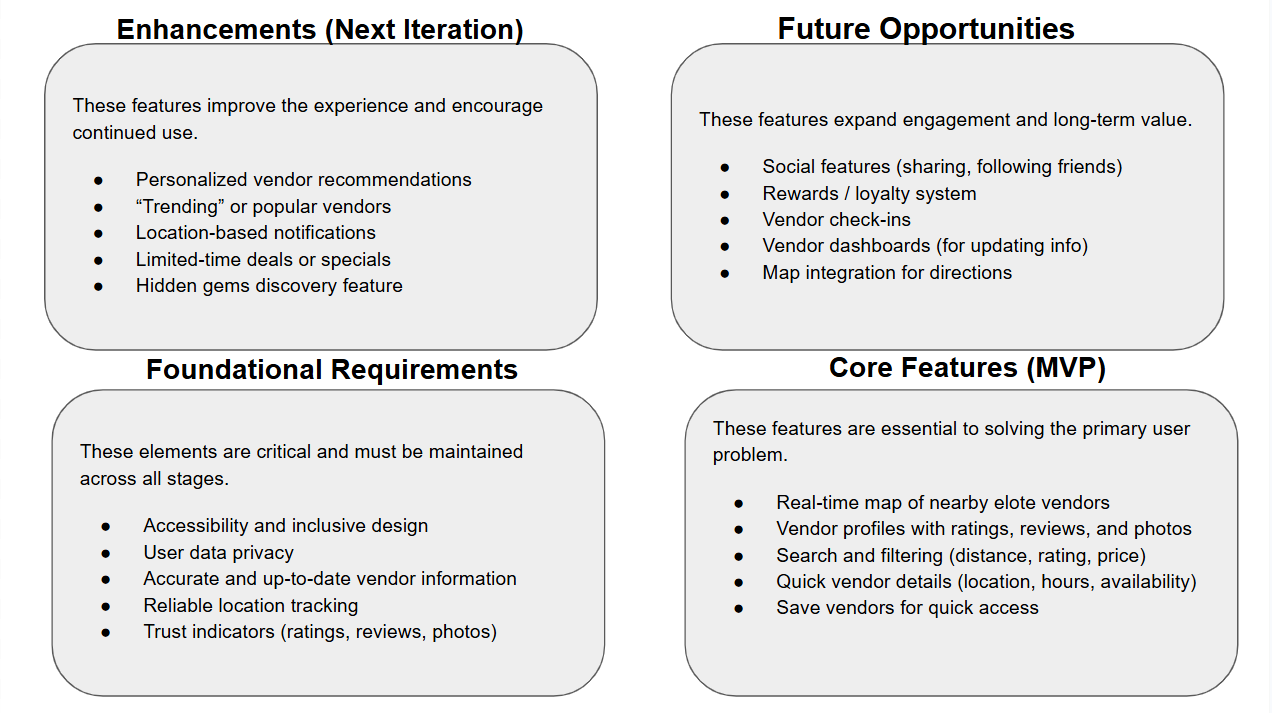
Based on insights gathered from user research, the following core features were prioritized for the app: a real-time map to locate nearby street vendors, vendor profiles with ratings and photos, search and filtering options, a quick-view of vendor details, and a saved vendors feature for easy access.
Additional features that were not included in the MVP but are important for future iterations include rewards or loyalty systems to encourage exploration, as well as social features that allow users to share recommendations or discover vendors through friends.
User Flows
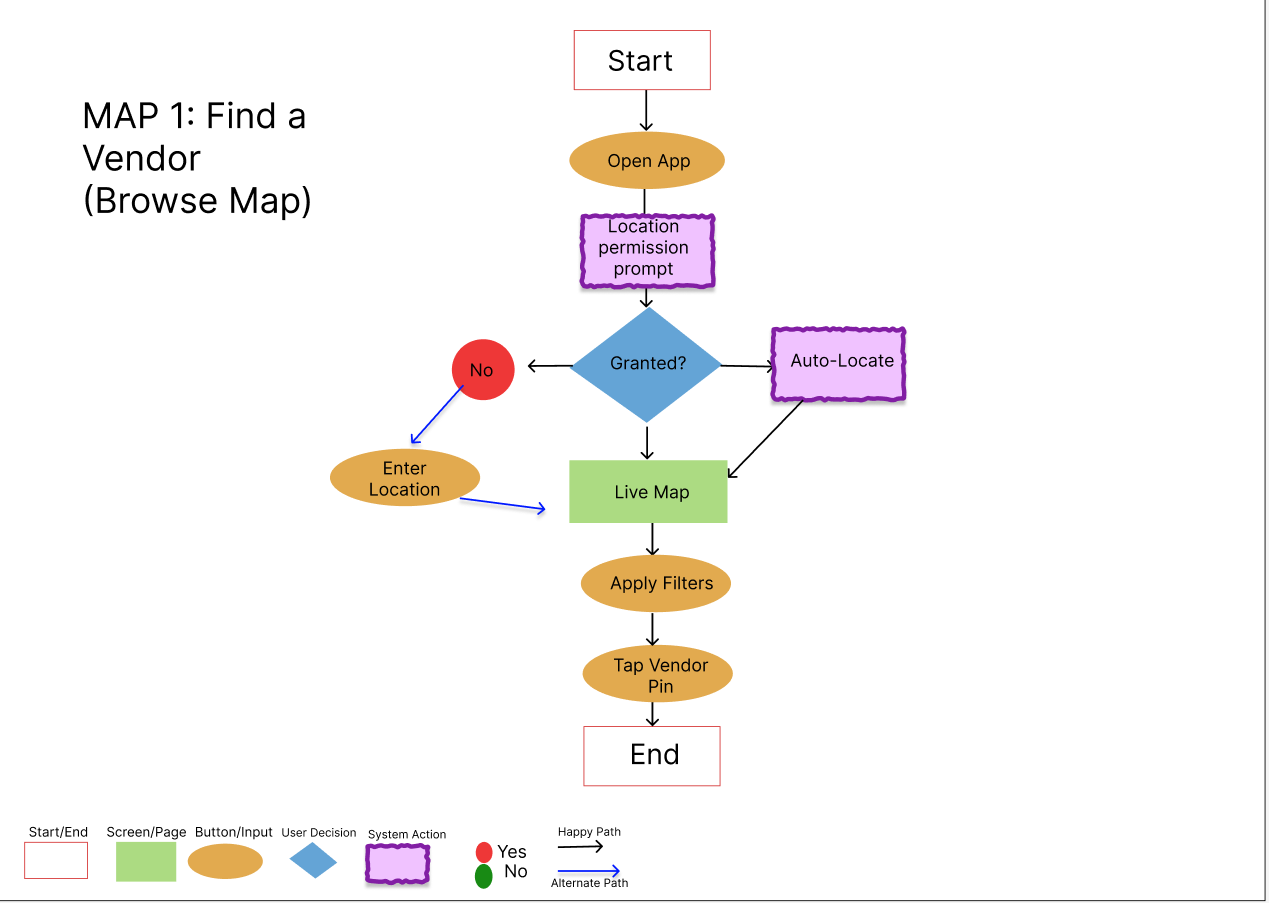
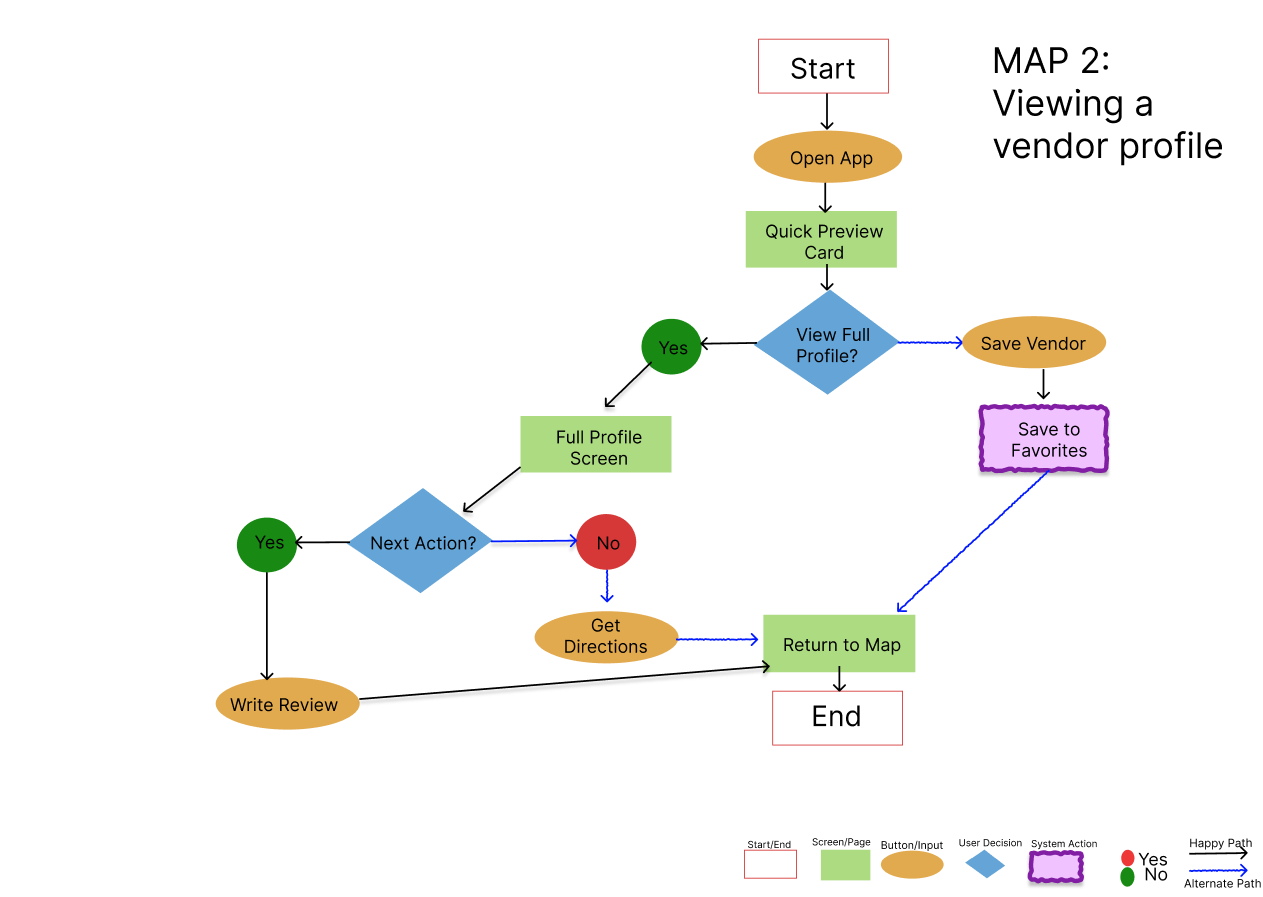
Two primary user flows were created to guide the design process and support future usability testing. The first outlines a simple onboarding experience that introduces users to the app and its key features. The second maps the different paths users can take to discover nearby street food vendors, view details, and decide on a vendor within a limited amount of time.
Site mapping
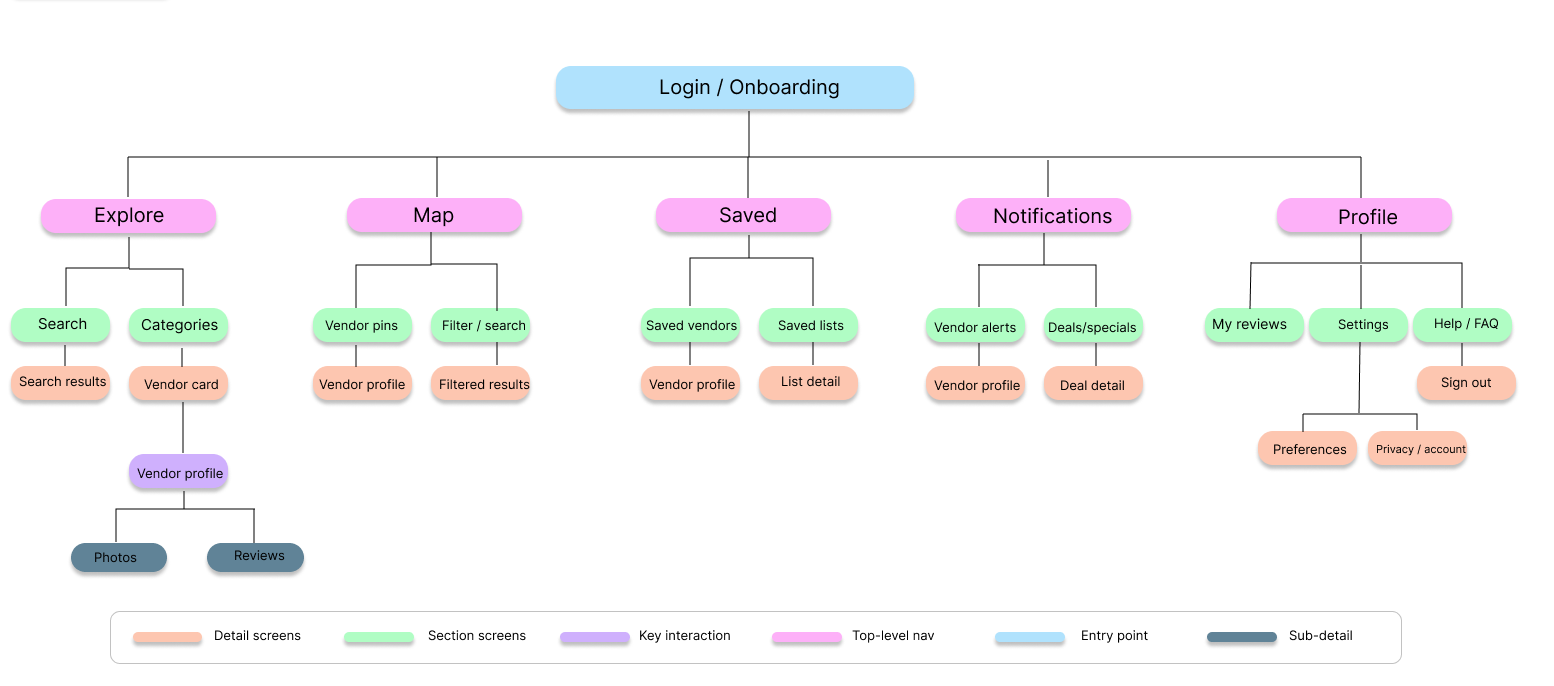
Informational architecture gave me the vision I needed to start wireframing.
Low-Fidelity Wireframing
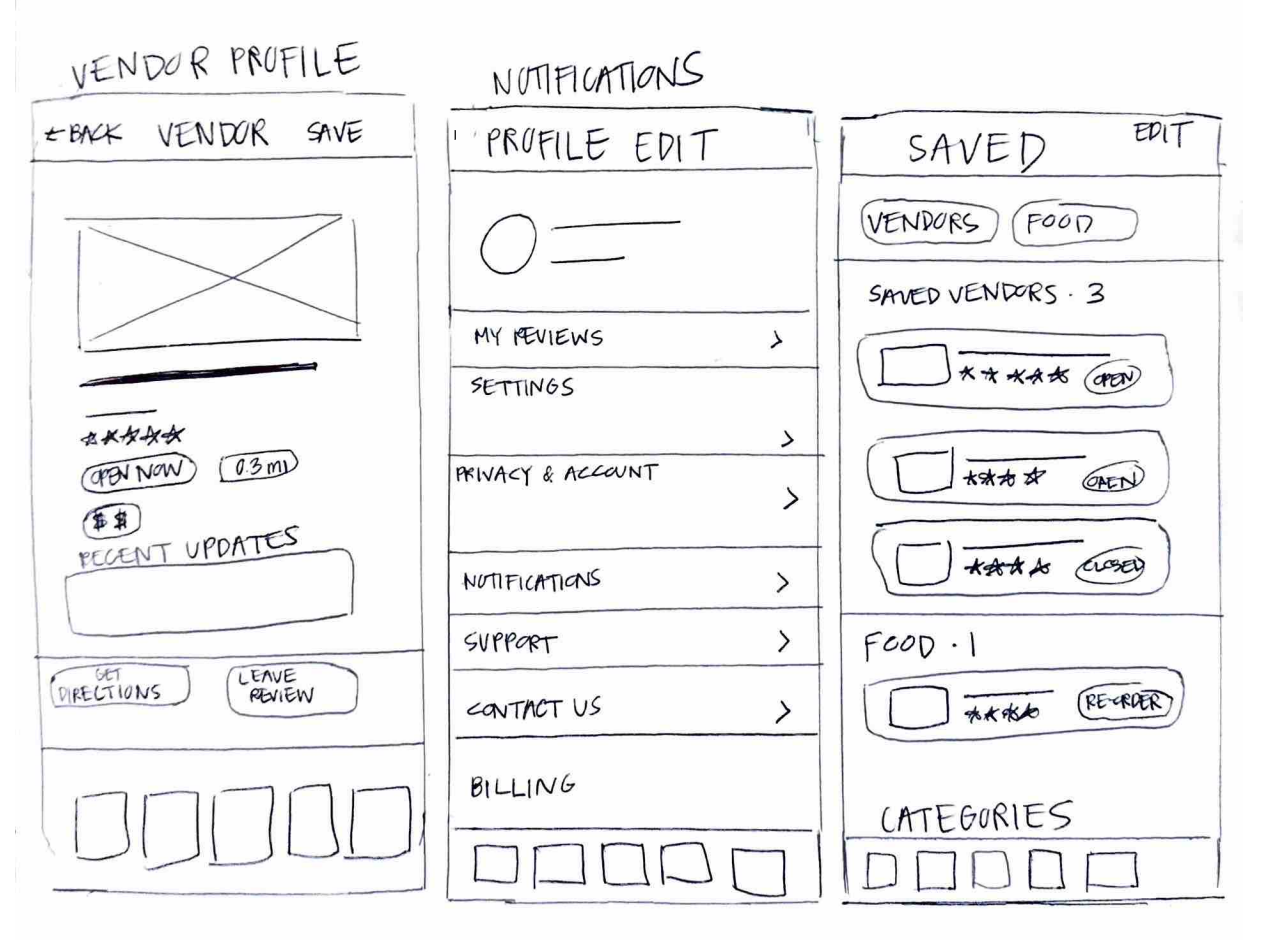
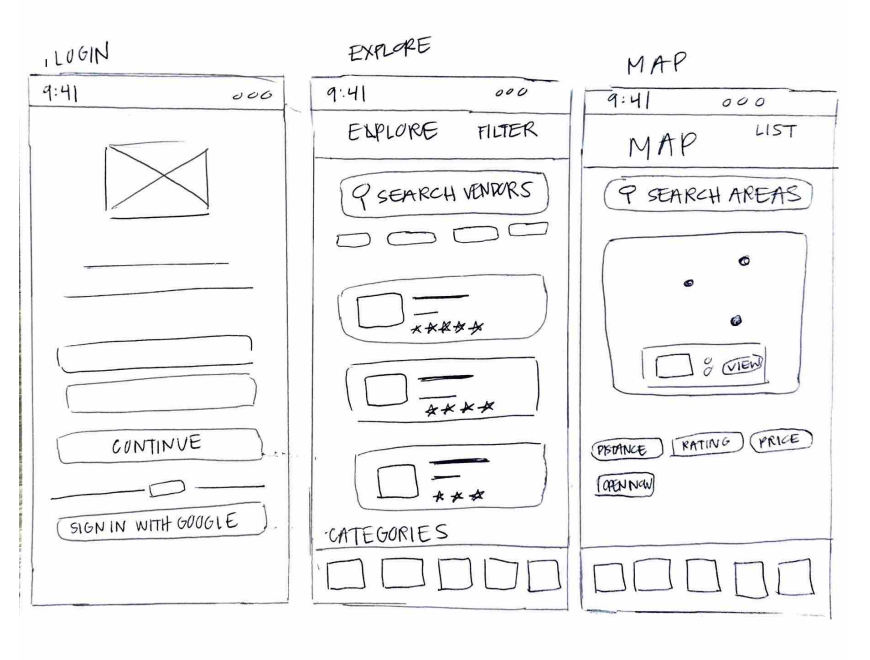
I sketched some low-fidelity wireframing to explore the basic layout, screen flow, and key features. This helped me quickly test out ideas for vendor search, map browsing, and overall navigation.
High-Fidelity Wireframing
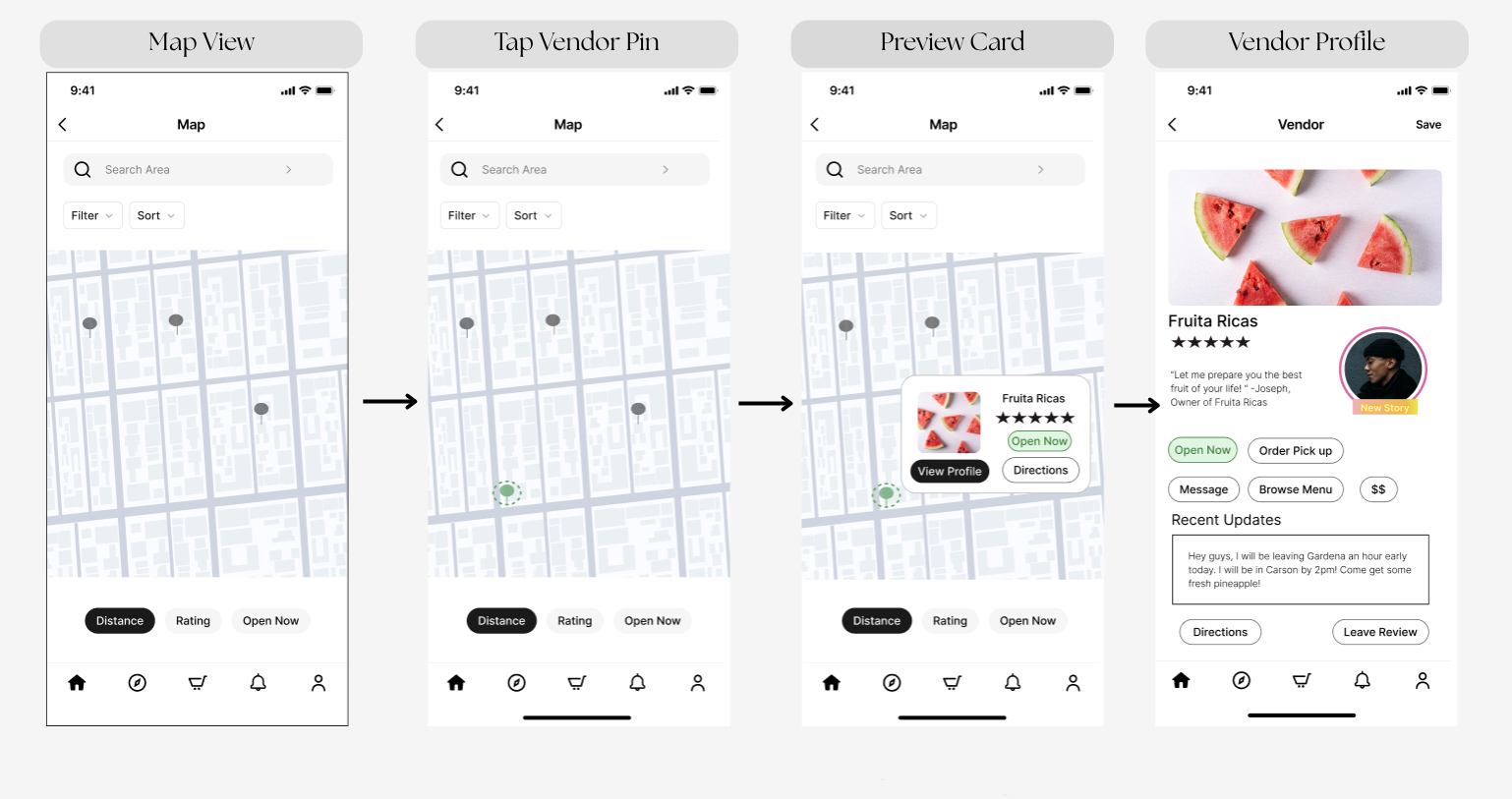
These high-fidelity wireframes illustrate the final user flow, showing how users can easily discover a street vendor, view details, and order from the map interface. I made these in Figma.Elote is a mobile app that helps users discover street vendors in real time, explore vendor profiles, and place pickup orders seamlessly. With built-in stories and live updates, vendors can share their location, availability, and offerings, creating a more reliable and engaging street food experience.
Prototype
This interactive prototype showcases the core user flow, from discovering nearby street vendors to viewing vendor details.

Testing & User feedback
This app was tested in person with five participants. User feedback played an important role in identifying areas for improvement. 4 of 5 testers expressed interest in a delivery option for vendors who are able to deliver, which could expand accessibility and convenience for users who may not always be nearby. 3 of 5 suggested a centralized dashboard where users can view all vendor updates in one place, rather than navigating between individual profiles. In response to this feedback, I began exploring the idea of an “Trending Stories” page that would aggregate vendor content, making it easier to browse updates, discover new vendors, and stay connected
Conclusion & Future Intentions
Elote addresses the challenge of discovering street vendors by creating a more reliable, accessible, and engaging experience for users. Through real-time location visibility, vendor profiles, and integrated pickup ordering, the app simplifies how people find and interact with street food vendors. Additionally, features like stories and live updates help build trust and keep users informed, making the experience feel dynamic and community-driven.
Moving forward, these insights highlight opportunities to further enhance the app by expanding its functionality while maintaining a simple and intuitive user experience. Future iterations of Elote will focus on improving content discovery, increasing flexibility through delivery options, and strengthening the connection between users and vendors.